$4 Trillion in Capital Investment: We Mapped 3,901 Projects Across 858 U.S. Counties
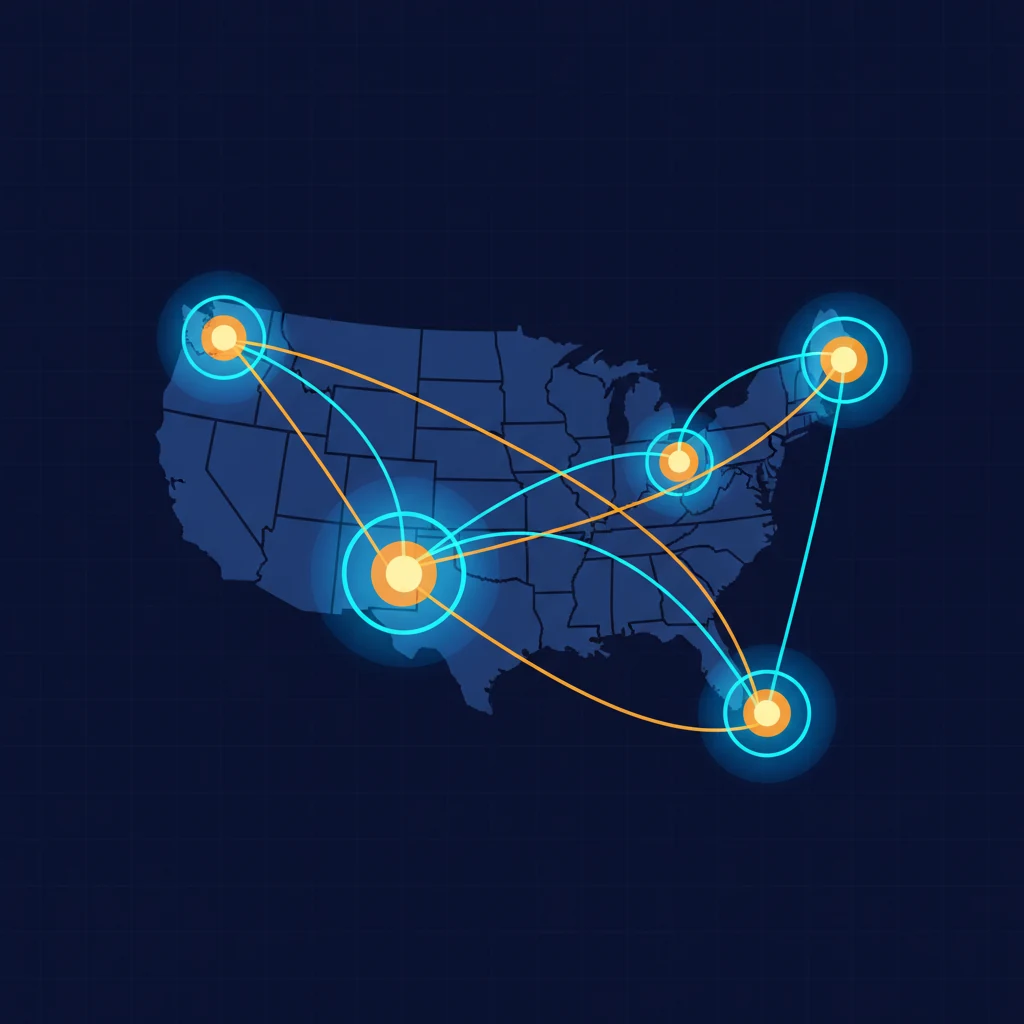
Over the last several months we built a county-level tracker of announced capital investment in the United States — the data centers, factories, energy projects, and infrastructure builds that show up in press releases, state economic-development filings, and corporate announcements.
858 counties have at least one tracked project. That's 27% of the country, but it's where 100% of the headline-grabbing capital is landing right now. The rest of this post walks through what that data shows: which sectors dominate, which states are winning, and which obscure rural counties are pulling in more capex than New York City.
Every dollar figure below comes from public announcements. None of it is verified to a primary source by hand — methodology is at the bottom of this post — but the directional picture is clear and the named projects can be cross-referenced. The full county ranking lives here; the state and county pages let you slice it any way you want.
Half of the money is going into one thing
The single biggest finding in the data: data centers absorb roughly half of all tracked capital investment in the United States right now. Not manufacturing. Not energy. Not infrastructure. Server farms.
| Sector | Tracked Investment | Share |
|---|---|---|
| Data Centers | $2.05T | 51% |
| Energy (renewables, LNG, grid) | $890B | 22% |
| Manufacturing | $590B | 15% |
| Infrastructure | $248B | 6% |
| Commercial / Residential | $210B | 5% |
| Industrial / Logistics + other | $56B | 1% |
The AI infrastructure boom has been visible in the financial press for two years now — Microsoft, Amazon, Google, Meta, and Oracle have all announced multi-hundred-billion-dollar capex plans — but seeing it concentrated at the county level makes the scale tangible. $2 trillion in announced data-center capex is roughly equivalent to the entire annual GDP of Brazil. It's flowing into 100-acre campuses spread across counties most Americans couldn't find on a map.
Energy is the other half of the AI story. A modern hyperscale data center campus pulls 500MW to 2GW of continuous power. That power has to come from somewhere, which is why the $890B energy bucket includes a wave of new gas generation, solar-plus-storage projects, and grid expansion specifically tied to data-center load. The two sectors are functionally one investment thesis.
The reshoring story is real, but smaller than you'd think
Manufacturing — the headline beneficiary of the CHIPS Act and the IRA — clocks in at $590B. Real money, but only about 15% of total announced capex. The biggest individual manufacturing project in the dataset is Micron Technology's $100B semiconductor facility in Onondaga County, New York, which is also one of the few mega-projects bringing significant jobs (9,029 announced, in a county that didn't have many great options after IBM downsized).
Other notable manufacturing landings: Hyundai-SK's EV battery plant in Bartow County, Georgia. Eli Lilly's pharmaceutical expansions across Indiana. The Hyundai EV complex in Bryan County, Georgia. The Texas semiconductor cluster around Austin and Sherman. These are real, located, named projects — not aggregated estimates — and they collectively employ tens of thousands of people.
But the broader reshoring narrative deserves a sober read of the numbers: data-center capex is roughly 3.5x larger than manufacturing capex in this dataset. The U.S. is not primarily building factories right now. It's building server farms, and the energy infrastructure to power them.
Where the money is going: state-level winners
Texas leads by a wide margin — partly because it's huge, partly because it has the cheapest power and most permissive permitting in the country, and partly because the data-center industry has clustered around Dallas-Fort Worth, the I-35 corridor, and the Permian Basin grid edge.
| State | Tracked Investment | Projects | Jobs Announced |
|---|---|---|---|
| Texas | $476.6B | 344 | 132,269 |
| New York | $351.1B | 176 | 55,486 |
| Virginia | $320.6B | 167 | 31,729 |
| Pennsylvania | $272.6B | 157 | 83,616 |
| Georgia | $247.3B | 173 | 46,543 |
| California | $198.7B | 191 | 82,670 |
| New Mexico | $188.9B | 46 | 6,592 |
| Missouri | $185.5B | 92 | 5,337 |
| Louisiana | $119.8B | 76 | 15,840 |
| North Carolina | $116.9B | 202 | 35,618 |
A few things to notice. Virginia's number ($320B) reflects its status as the world's largest data-center market — Loudoun County alone hosts more server capacity than most countries. New Mexico's $188B is essentially one project (more on that next). Pennsylvania and Georgia have the strongest jobs numbers per dollar — manufacturing projects, which actually employ humans, are concentrated there.
Each state page now has a Capital Investment card showing the same data sliced by state — sector mix, top counties within the state, largest individual projects, and a CSV download. The Texas card is the most data-rich; the Virginia card tells the data-center story most clearly.
The boomtowns no one is talking about
The real surprise in the data isn't which states are winning. It's which counties are landing the biggest individual deals — places most people have never heard of, suddenly becoming the geography of the AI build-out.
| County | State | Tracked Investment | Anchor Project |
|---|---|---|---|
| Doña Ana County | NM | $165.3B | Project Jupiter (STACK / Oracle / OpenAI data center campus) |
| Virginia Beach | VA | $120.2B | Amazon robotics fulfillment + data center cluster |
| Platte County | MO | $101.2B | Project Kestrel (hyperscale data center campus) |
| Onondaga County | NY | $100.3B | Micron Technology semiconductor facility |
| Pittsylvania County | VA | $76.7B | Southern Virginia Megasite (Stack Infrastructure) |
| Sullivan County | NY | $65.3B | Heartland Industrial Park data center campus |
| Jefferson County | TX | $57.2B | Industrial expansion + Port Arthur LNG facilities |
| Laramie County | WY | $53.2B | Cheyenne data-center cluster |
Doña Ana County, on the New Mexico-Texas border, is the headline. Population ~220,000. Median household income below the national average. Until very recently, it was a mostly-rural county whose biggest claim to fame was White Sands Missile Range. Now it's the announced site of Project Jupiter, a multi-phase data center campus from STACK Infrastructure and BorderPlex Digital Assets, with Oracle and OpenAI as anchor tenants. The headline figure is $165B over the full build-out.
Platte County, Missouri, is the same story in a different state. Population ~110,000, just north of Kansas City. The Port KC public-private partnership is positioning the county for "Project Kestrel," a hyperscale campus whose ultimate tenant has not been publicly disclosed but whose announced footprint is in the $100B range.
What ties these counties together: cheap power, available land, willing local governments, and proximity to the trunk fiber networks that hyperscale data centers need. The geography of the AI build-out is not Silicon Valley or Manhattan. It's tertiary counties with industrial parks, low population density, and grid headroom.
Why this matters for boom-town predictions
The thesis of BoomTownIndex is that economic momentum is more predictable than people think — population growth, wage growth, and home-price appreciation tend to lag underlying capital-investment flows by 2 to 5 years. A county that lands a $50B+ campus today will see job growth in 2027-2029, in-migration in 2028-2030, and home-price acceleration shortly after.
That's why we're now surfacing this data on every state and county page. The investment ranking is a leading indicator of which counties are about to show up on the population-growth and home-price-growth rankings two to five years from now. Doña Ana County's BoomTown Index score today is mid-pack. Its score in 2030, if Project Jupiter ships on schedule, will look very different.
None of this is a guaranteed forecast. Mega-projects get scaled back. AI capex cycles can deflate. State EDC announcements include estimates that don't fully materialize. But the directional signal is real: capital flows lead the population data, and the population data lead the home-price data. Tracking the leading indicator is the whole point.
Methodology and limitations
Every dataset has caveats. This one has more than most. Worth being transparent about them.
- Source. The dataset was compiled from public announcements — corporate press releases, state economic-development agency filings, news coverage, and company investor presentations — using AI-assisted research. Each county's project list was generated by Gemini 2.5 with web-search grounding, then aggregated.
- Threshold. Only projects with $25M+ in announced investment OR 500+ jobs make the cut. Smaller projects exist but aren't tracked at this granularity.
- Verification. Aggregate figures and named-project headlines are directionally correct but not independently verified to primary sources. The largest announcements (Project Jupiter, Project Kestrel, Micron Onondaga) are well-documented in financial press; smaller projects may have rounding-down or naming-convention issues. We accept the trade-off — coverage breadth over per-row precision — and we welcome corrections (see below).
- Phasing. Headline dollar figures typically reflect full-build-out totals over multi-year horizons, not annual deployment. Treat them as announced commitments, not realized capex.
- Coverage gaps. 27% of U.S. counties have at least one tracked project. The other 73% may have small or unannounced investments not visible to public-source aggregation. Absence of data is not absence of investment.
- Updates. The dataset gets refreshed in batches as new announcements land. Last updated April 30, 2026.
For more on the methodology BoomTownIndex uses to convert this data into county rankings, see our methodology page. For an explainer on how we score housing valuations using local economic output, see the Housing P/E Ratio post. For a worked example of why our rankings sometimes flag counties as fast-growing despite higher crime rates, see The Boom Town Safety Paradox.